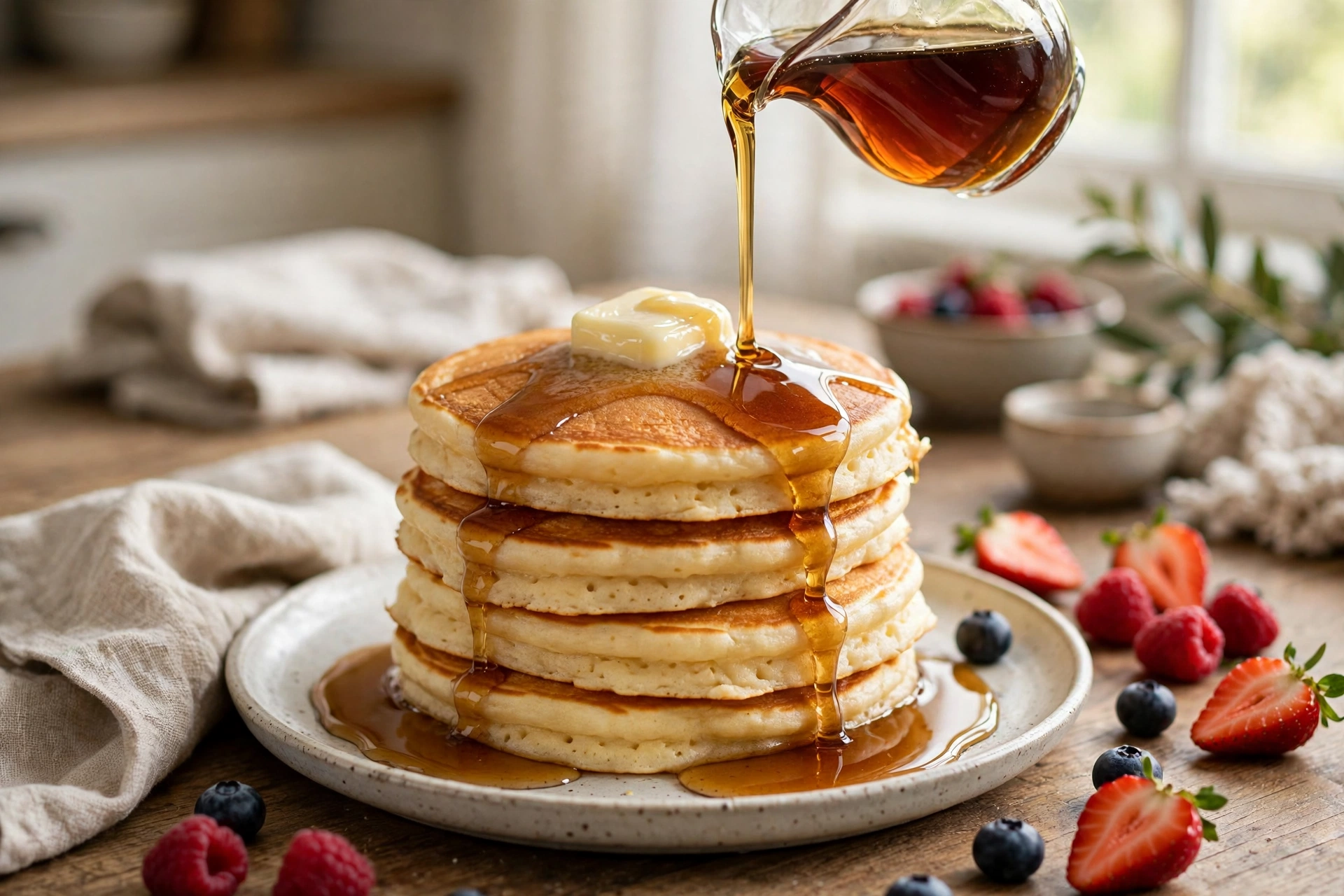
Good pancakes should be tall. Not cake tall, not soufflé tall, just properly puffed, with golden edges, a soft middle that steams when you cut in, and enough structure to hold butter and syrup without collapsing into a soggy disc. That is the whole goal here.
Box mix can get you close on a sleepy morning. These get you closer to the diner plate, the short stack that arrives still warm all the way through. Buttermilk does a lot of the work. So does a light hand. In our kitchen we make these for slow breakfasts and, just as often, for breakfast at dinner time when nobody can agree on anything else. Twenty minutes. A bag of flour. A hot griddle. Done.
Tall, Fluffy, and Not From a Box
The lift starts with a simple reaction. Buttermilk is acidic. Baking soda is not. When they meet, they make tiny bubbles of carbon dioxide all through the batter, and those bubbles expand in the heat of the griddle and push the pancake up from the inside. You can see it happen if you watch the edges. They set, they puff, they stop looking wet.
Baking powder gives a second, slower rise on top of that. One leavener starts fast, the other keeps going, so the pancakes stay puffy instead of deflating the second they leave the pan. It is a small redundancy that makes the recipe forgiving.
Resting matters more than most people think. Five to ten minutes lets the flour hydrate fully and lets the gluten relax, so the crumb stays tender instead of chewy. Skip the rest and they still cook, sure, but they eat a little tougher. Wait the few minutes. Put the coffee on.
A hot, lightly greased surface gives you lacy golden edges and even browning. Too cool and the pancakes steam, pale and limp. Too hot and the outside darkens before the center is done. One gentle flip, at the right moment, keeps the trapped air inside.
What Goes in the Batter
This makes about 10 medium pancakes, enough for a family of four with a couple left over for tomorrow’s toaster. Everything here is a basic pantry staple.
- 2 cups all-purpose flour
- 2 tablespoons granulated sugar
- 2 teaspoons baking powder
- 1 teaspoon baking soda
- 1 teaspoon fine salt
- 2 cups buttermilk, shaken well
- 2 large eggs, at room temperature
- 4 tablespoons unsalted butter, melted, plus more for the griddle
- 1 teaspoon vanilla extract
Real buttermilk makes a noticeable difference in flavor and rise, so use it if you can. The tang is gentle, not sour, and the thickness helps the batter stay thick too. Thin batter makes thin pancakes.
In a pinch, stir 2 tablespoons of white vinegar or lemon juice into 2 cups of regular milk and let it sit for five minutes until it curdles slightly. Whole milk gives the richest result, but 2 percent works fine. If your buttermilk is very thick, the batter will be thick as well, which is good. Salted butter is fine for the griddle, just skip a pinch of the salt in the dry mix if you use it in the batter as well. Butter tastes better on the griddle. Oil works if you must, but you will miss a little flavor at the edges.
From Bowl to Griddle
- In a large mixing bowl, whisk together the flour, sugar, baking powder, baking soda, and salt until everything is evenly combined and there are no pockets of soda left.
- In a second bowl or large measuring jug, whisk the buttermilk, eggs, melted butter, and vanilla until smooth. Pour the wet mixture into the dry ingredients.
- Stir with a spatula just until the flour disappears, about 10 to 12 strokes. The batter must stay lumpy. If it looks perfectly smooth, you have already stirred too much.
- Set the bowl aside and let the batter rest for 5 to 10 minutes. You will see small bubbles forming on the surface, which is exactly what you want.
- Heat a griddle or large skillet over medium heat. It is ready when a few drops of water flicked onto the surface dance and evaporate quickly. Lightly grease with butter.
- Pour about 1/3 cup of batter per pancake, leaving space between them. Cook for 2 to 3 minutes, until bubbles cover the surface and the edges look set and slightly dry.
- Flip once, gently, and cook the second side for 1 to 2 minutes more, until deep golden. Do not press down with the spatula, that squeezes out the air you worked to create.
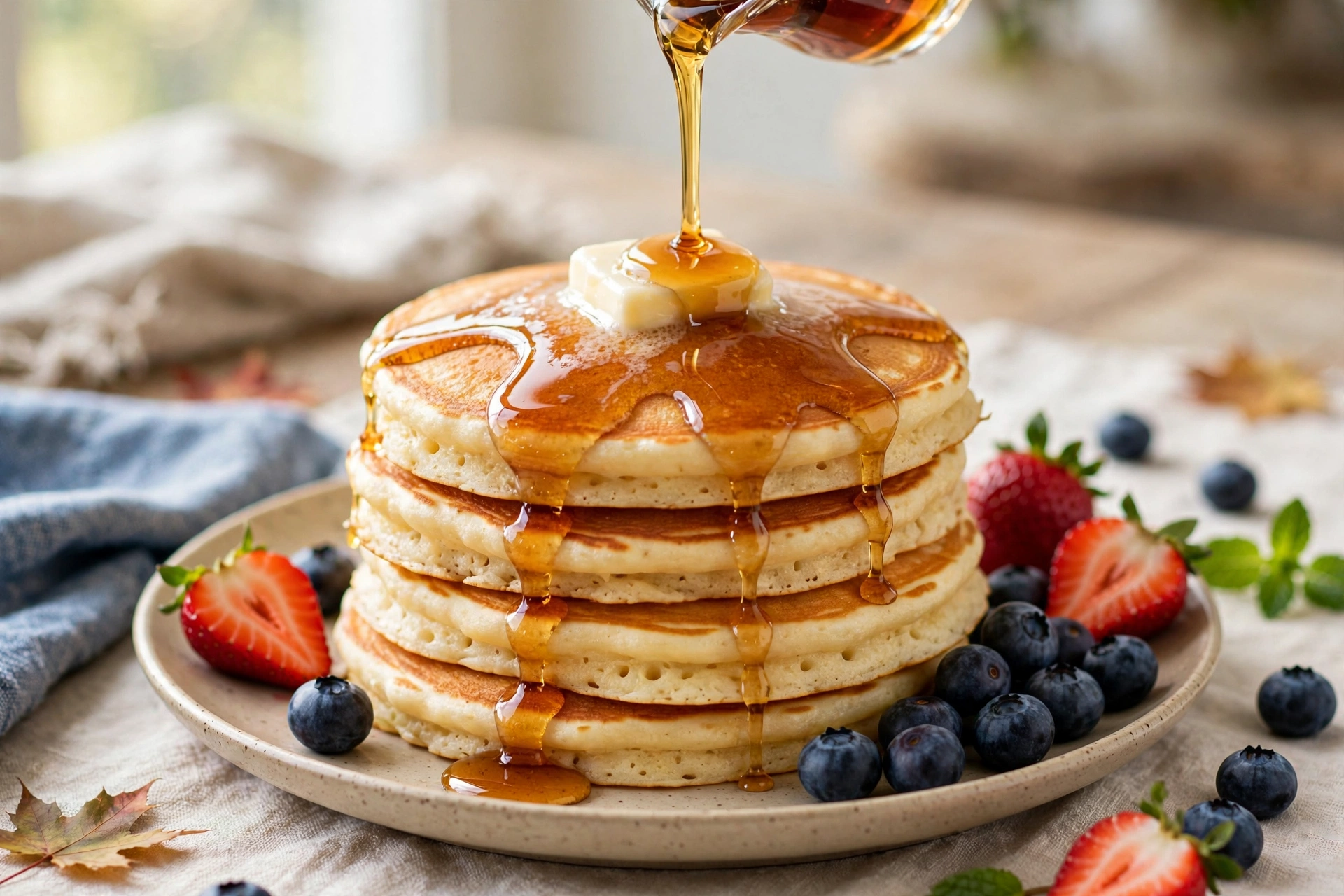
- Serve right away in warm stacks with butter and maple syrup. Keep finished pancakes warm on a sheet pan in a 200 degree F oven while you finish the batch.
Why Pancakes Go Flat (and How to Stop It)
- Measure the flour lightly. Spoon flour into the cup and level it off instead of scooping from the bag. A packed cup can add a quarter cup extra flour and make the pancakes dense. It is an easy mistake. It is also an easy fix.
- Trust the bubbles, not the clock. Every stove runs a little different. Flip when the surface is covered with bubbles that start to pop and stay open, and the edges look matte instead of shiny. The pancake will tell you. You just have to look.
- Keep the heat at medium. A screaming hot griddle burns the outside before the center cooks through. If the first pancake browns too fast, turn the heat down a notch and wait a minute. Patience here saves the whole batch.
- Use the first pancake as a test. Cooks have done this forever. Taste it, adjust the heat and the batter thickness, and the rest of the batch will come out right. Call it quality control. Eat it standing at the stove.
- Wipe the griddle between batches. Old butter burns and turns bitter. A quick wipe with a folded paper towel and a fresh dab of butter keeps every round tasting clean, with no dark specks and no burnt smell.
- Leave the lumps alone. It goes against instinct, but small lumps in the batter are pockets that cook up tender. Every extra stir makes the pancakes a little tougher, so put the spatula down sooner than feels natural.
Toppings and Twists
Blueberry pancakes are the favorite variation in our kitchen: drop a small handful of fresh or frozen blueberries onto each pancake right after you pour the batter, before flipping. They burst a little in the heat. No need to fold them into the bowl, where they sink and streak everything blue-grey.
For chocolate chip pancakes, fold in 1/2 cup of mini chocolate chips. A fall version uses 1 teaspoon of cinnamon and a pinch of nutmeg in the dry mix, served with warm applesauce. Cozy. A little different.
For whole wheat pancakes, swap half the all-purpose flour for whole wheat flour and add one extra tablespoon of buttermilk, since whole wheat drinks up more liquid. To make them dairy-free, use the vinegar and oat milk trick above and melted coconut oil instead of butter. The rise will be slightly less dramatic, but they still come out soft and very good.
Freezing and Reheating
Leftover pancakes keep well in an airtight container in the refrigerator for up to 3 days. For longer storage, freeze them in a single layer on a sheet pan, then stack them in a freezer bag with small squares of parchment between each one. They keep for up to 2 months.
The best way to reheat is the toaster on a medium setting, which brings back the crisp edges. A 300 degree F oven for 5 to 6 minutes also works for a big batch. The microwave is fine in a hurry, about 20 seconds per pancake, though the texture will be softer.
Pancake Questions
Why did my pancakes come out flat?
The usual culprit is old baking powder or baking soda that has lost its strength, so check the dates on your boxes. Overmixing the batter is the second most common reason, because it knocks out the bubbles and develops gluten. Stir less next time. Rest the batter. Those two changes fix most flat batches.
Can I make the batter the night before?
It is not recommended. The baking soda starts reacting as soon as it meets the buttermilk, so by morning most of the lift is gone. If mornings are rushed, mix the dry ingredients the night before and stir in the wet ones fresh. That saves most of the time without giving up the rise.
What if I do not have buttermilk?
Stir 2 tablespoons of white vinegar or lemon juice into 2 cups of milk and wait five minutes. It will not be quite as tangy or thick as real buttermilk, but the acid still activates the soda and the pancakes rise nicely. Use whole milk if you have it. The extra richness helps.
How do I keep pancakes warm for a crowd?
Hold them in a single layer on a sheet pan in a 200 degree F oven for up to 30 minutes. Stacking them in the oven makes the bottom ones soggy, so keep them spread out until serving time. One layer. It takes a bigger pan, but the texture thanks you.
Why is the first pancake always the worst one?
The first pancake is your griddle test, not a failure. The pan is still evening out its heat and soaking up the first butter, so that pancake often cooks unevenly or comes out a little pale. Eat it standing at the stove, adjust the heat if you need to, and know the rest of the batch will behave.
The Card
- Prep time: 10 minutes
- Cook time: 15 minutes
- Total time: 25 minutes
- Servings: 4 (about 10 pancakes)
- Calories: 340 per serving (estimated)