
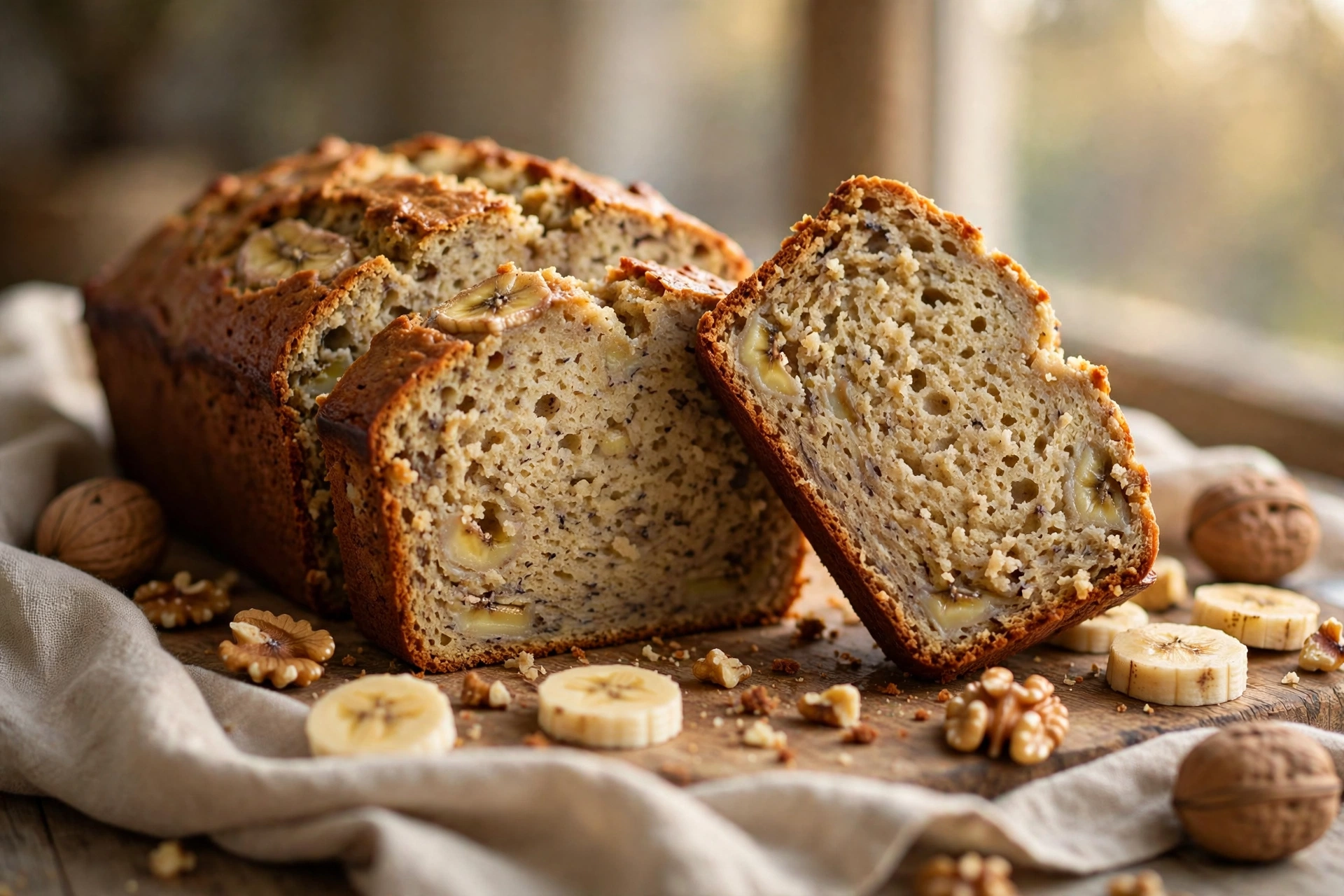
I have a confession: for the first year after my sister was diagnosed with celiac disease, my gluten-free baking was terrible. Dry, crumbly, with that unmistakable gritty aftertaste that makes everyone at the table politely reach for water. She would smile and say “it is fine, really,” which is sister-code for “please stop.” I became mildly obsessed after that. I tested eleven versions of banana bread in one month — my neighbors started hiding when they saw me coming with another foil-wrapped loaf — until I landed on this one. The version where my sister took a bite, went quiet, and said, “Okay. This one is actually better than regular.”
That is the bar this recipe clears. It is deeply moist without being gummy, tender without falling apart, and it tastes like banana bread first and gluten-free second — which is exactly how it should be. The method is one bowl and a whisk, no mixer, no complicated flour alchemy. If you have been disappointed by gluten-free baking before, I made this recipe for you.
Why You’ll Love This Recipe
- Genuinely moist for days: This is not “good for gluten-free” — it stays soft and tender for three full days, which is the real test.
- One bowl, no mixer: Whisk everything in a single bowl. Fewer dishes, less fuss, same great loaf.
- Intensely banana-flavored: Three very ripe bananas plus brown sugar give it that deep, caramelly banana taste.
- Freezer-friendly: Bake two loaves, freeze one, and future-you will be very grateful.
- Customizable: Add walnuts, chocolate chips, or a cinnamon swirl — the base recipe handles all of it.
- Kid-approved: My kids cannot tell the difference between this and the “regular” banana bread I used to make.
Ingredients
The flour blend matters more than anything else here. Use a good all-purpose gluten-free flour blend that already contains xanthan gum — I have had the best results with the widely available cup-for-cup style blends. If your blend does not include xanthan gum, add 1 teaspoon of it; without a binder, the loaf will be crumbly. And the bananas: they should be heavily spotted, nearly black in places. Under-ripe bananas make bland, dry bread. I keep a bag of peeled overripe bananas in my freezer just for this recipe.
- 3 very ripe bananas (about 1 1/2 cups mashed)
- 1/2 cup unsalted butter, melted and slightly cooled (or coconut oil for dairy-free)
- 3/4 cup packed light brown sugar
- 1/4 cup granulated sugar
- 2 large eggs, at room temperature
- 1 teaspoon pure vanilla extract
- 1 3/4 cups gluten-free all-purpose flour blend (with xanthan gum)
- 1 teaspoon baking soda
- 1/2 teaspoon fine sea salt
- 1 teaspoon ground cinnamon
- 1/4 teaspoon ground nutmeg (optional)
- 1/2 cup chopped walnuts (optional)
- 1/2 cup chocolate chips (optional)
Step-by-Step Instructions
Prep time: 15 minutes | Cook time: 55-60 minutes | Total time: 1 hour 15 minutes | Servings: 10 slices | Calories: ~250 per slice (estimated, without add-ins)
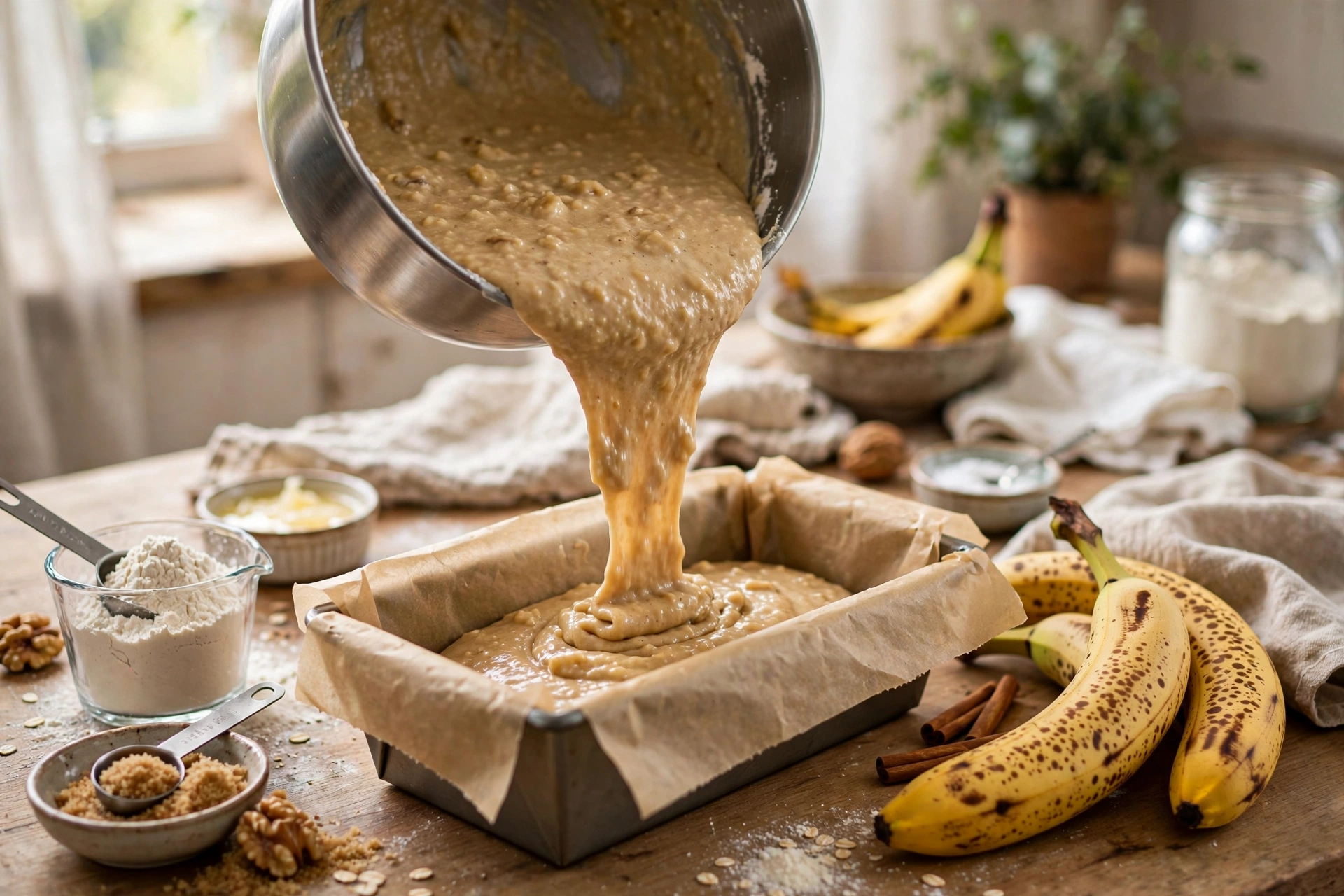
- Heat the oven and prep the pan. Preheat the oven to 350°F. Grease a 9×5-inch loaf pan with butter or cooking spray, then line it with parchment paper leaving overhang on the two long sides. That parchment sling is the difference between a beautiful loaf and one you have to chisel out of the pan — trust me on this.
- Mash the bananas. In a large mixing bowl, mash the bananas with a fork until mostly smooth. A few small lumps are fine and actually give the bread lovely pockets of banana flavor. You want about 1 1/2 cups. If your bananas are frozen, thaw them completely and drain off the excess liquid first.
- Mix the wet ingredients. Whisk the melted butter into the mashed bananas, then whisk in the brown sugar and granulated sugar until combined. Add the eggs one at a time, whisking well after each, then stir in the vanilla. The mixture will look glossy and smell like the start of something wonderful.
- Add the dry ingredients. Sprinkle the gluten-free flour, baking soda, salt, cinnamon, and nutmeg (if using) evenly over the wet mixture. Switch to a spatula and fold gently until just combined — no dry streaks remain, but stop there. Overmixing develops toughness even in gluten-free batter, and it deflates the air that keeps the crumb tender. Fold in the walnuts or chocolate chips now if you are using them.
- Fill the pan. Scrape the batter into the prepared loaf pan and smooth the top. For a pretty bakery-style finish, press a few extra walnut halves or chocolate chips into the top, and lay one thin banana slice lengthwise down the center if you are feeling fancy.
- Bake. Bake for 55 to 60 minutes, until the top is deeply golden and a toothpick inserted into the center comes out with a few moist crumbs clinging to it — not wet batter, but not bone dry either. If the top is browning too fast after 40 minutes, tent it loosely with foil. Every oven runs a little different, so start checking at 50 minutes.
- Cool properly. This step is non-negotiable for gluten-free bread: let the loaf cool in the pan for 15 minutes, then lift it out using the parchment sling and cool completely on a wire rack, at least 1 hour. Cutting too early releases steam that the crumb needs to set, and you will get a gummy texture. I know it is hard. Go fold laundry or something.
Pro Tips
- Bananas must be very ripe. Heavily spotted, soft, fragrant — the kind you would never eat out of hand. Ripeness equals moisture and sweetness; this is the soul of the recipe.
- Measure flour correctly. Spoon the gluten-free flour into your measuring cup and level it off. Scooping packs it down and too much flour is the fastest route to dry bread.
- Room-temperature eggs mix better. Cold eggs can cause the melted butter to seize into little clumps. Set the eggs in warm water for 5 minutes if you forgot to take them out.
- Do not overbake. Gluten-free bread goes from perfect to dry quickly. Moist crumbs on the toothpick is the goal — carryover heat finishes the job.
- Cool completely before slicing. I said it above and I will say it again, because this is where most gluten-free banana bread fails. Patience pays off.
Variations
The base loaf is a canvas. Chocolate chip banana bread is the crowd favorite in my house — use 3/4 cup of semisweet chips and skip the walnuts. For a cinnamon-swirl version, pour half the batter into the pan, sprinkle with a mix of 2 tablespoons sugar and 1 teaspoon cinnamon, add the remaining batter, and swirl once with a knife. Blueberry banana bread works beautifully too: fold in 3/4 cup of fresh blueberries tossed in a spoonful of flour so they do not sink. For muffins, divide the batter among 12 lined muffin cups and bake at 350°F for 20 to 24 minutes. And for a dairy-free loaf, swap the butter for melted coconut oil — the flavor is lovely, faintly tropical, and nobody will guess.
Storage & Reheating
Store the cooled loaf tightly wrapped in plastic wrap or in an airtight container at room temperature for up to 3 days — it stays remarkably moist. For longer storage, refrigerate for up to a week; bring slices to room temperature or warm them for 10 seconds in the microwave before serving, because cold mutes the flavor. To freeze, wrap the whole cooled loaf (or individual slices) tightly in plastic wrap, then in foil, and freeze for up to 3 months. Thaw overnight on the counter still wrapped, so condensation forms on the wrapping instead of the bread. Toasted slices with a smear of butter are, in my opinion, the highest form this bread can take.
FAQs
Why is my gluten-free banana bread dry or crumbly?
The three usual culprits: under-ripe bananas, too much flour from scooping instead of spooning, or overbaking. Also check that your flour blend contains xanthan gum — without it, the loaf has nothing holding the crumb together. This recipe is specifically built to avoid all three problems.
Can I make this banana bread dairy-free?
Yes. Replace the butter with an equal amount of melted coconut oil or a dairy-free butter alternative. The texture stays moist and tender, and the coconut oil adds a subtle flavor that pairs nicely with banana.
Can I reduce the sugar?
You can cut the total sugar to 3/4 cup without structural problems, but the bread will be less moist and less tender — sugar does real work in baking beyond sweetness. Make sure your bananas are extra ripe to compensate, since their natural sugars will carry more of the load.
Can I make these as muffins instead of a loaf?
Absolutely. Line a 12-cup muffin tin with paper liners, fill each about three-quarters full, and bake at 350°F for 20 to 24 minutes, until a toothpick comes out with moist crumbs. Muffins are great for lunchboxes and they freeze perfectly.
For more celiac-friendly baking, see all my gluten-free recipes, learn about my baking journey on my about page, or head back to the homepage for the latest posts.